Norwich compresses a thousand years of history into a walk you can comfortably finish before teatime. Elm Hill and the Cathedral Quarter sit a few minutes apart, and the ground between them is cobbled, flint-walled and full of small decisions: which gate to enter, which tea room to sit in, how far to walk before lunch. What follows is a route that works at an unhurried pace, with time deliberately built in for sitting down.
The Route at a Glance
The full circuit is roughly a mile and a half, and you can stretch or shorten it without missing anything essential. Start mid-morning, when the market is awake but the day-trippers have not yet arrived.
- Breakfast or coffee at Norwich Market, then a look at the Guildhall.
- Queen Street to Tombland, in the shadow of the cathedral gates.
- Down Elm Hill while the light is still good on the timber fronts.
- Back up to Erpingham Gate and into the Cathedral Close.
- Lunch, then the cloisters and the cathedral itself.
- Palace Street and Bishopgate down to Pull's Ferry.
- Riverside Walk to Cow Tower, then back through the Close to the market.
Start at the Market
Norwich Market has traded on broadly the same patch since the Norman period and remains one of the largest open-air markets in England — rows of striped stalls selling everything from fabric to falafel. Most traders work Monday to Saturday, so Sunday is a quieter start to the day and the wrong morning to rely on a market breakfast.
Eat standing up, then walk the short distance to the flint-built Guildhall on Gaol Hill, which has watched over the market since the fifteenth century. From there, Queen Street runs down to Tombland, the broad open square that served as the Saxon town's marketplace before the Normans moved the action uphill.
Tombland, the Gates and Elm Hill
Two medieval gates lead from Tombland into the Cathedral Close, and they are worth a proper look before you disappear down the hill. The Erpingham Gate, built in the 1420s, is named for Sir Thomas Erpingham, who commanded the archers at Agincourt. The Ethelbert Gate, older and lower, is a lovely piece of flint and stone work with a story attached — it was rebuilt partly as penance after a riot between town and cloister in the thirteenth century.
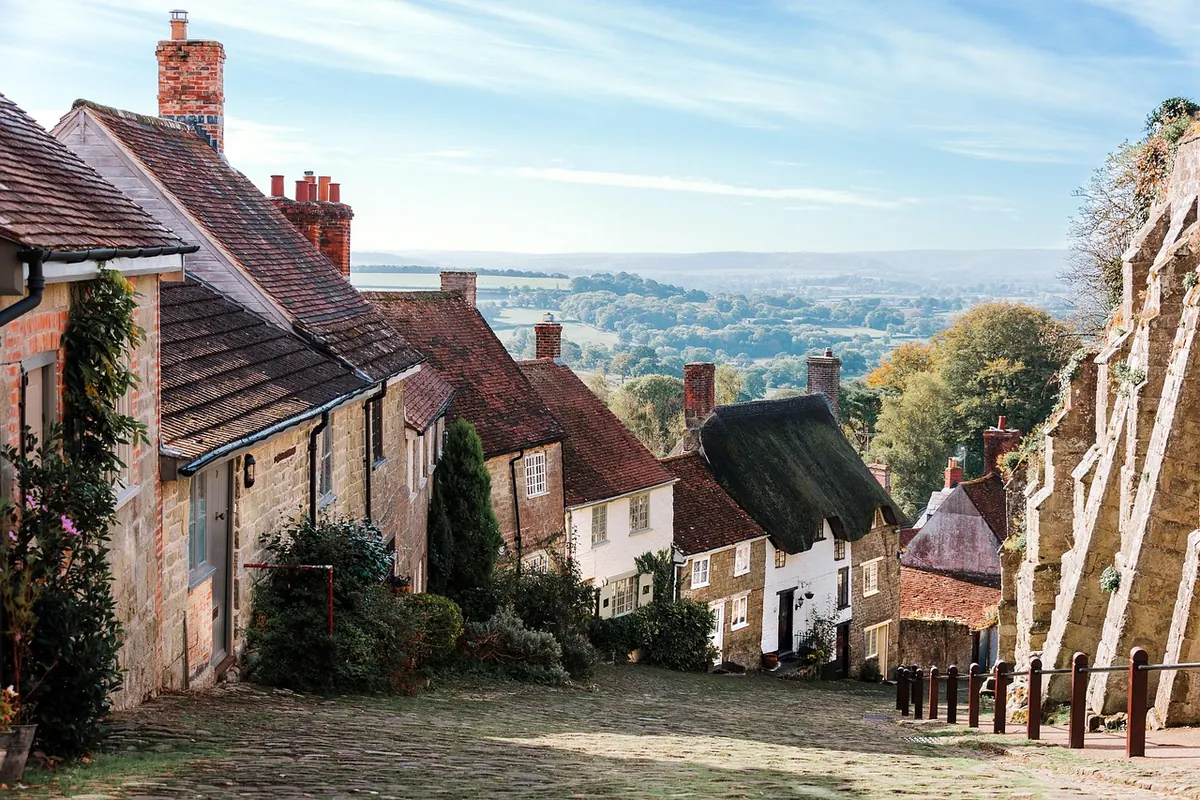
Save both for later. Instead, take Elm Hill, which drops downhill towards the Wensum and is the single most photographed street in the city. Much of what you see was rebuilt after a serious fire in 1507, which is why the street has such a coherent run of jettied timber houses rather than a jumble of periods. It is short — you can walk it in four minutes — but it rewards slowness.
What to Notice on Elm Hill
- Upper floors that lean out over the pavement, supported on carved brackets. Stand back and look up, not just along.
- St Peter Hungate at the top of the hill, a fifteenth-century church that lost its congregation and gained a second life as a heritage building.
- The Britons Arms on the corner, a timber-framed survivor with a courtyard garden behind it.
- The old church of St Simon and St Jude near the bottom, another redundant building that has worn several hats since.
- Painted signs and ironwork brackets, most of them far older than they look.
The cobbles are genuine and uneven, and the slope is real. Flat shoes are not a suggestion here, they are a requirement.
Into the Cathedral Close
Turn around and climb back to Tombland, then go through the Erpingham Gate. The change of atmosphere is immediate: traffic noise drops away, and you are standing in one of the largest cathedral closes in England, a green and largely car-free enclosure of Georgian and medieval buildings.
Take the path around the north side first. You will pass the Deanery, the cathedral's own school — founded with the bishopric in the eleventh century — and the long flint frontages of the former monastic buildings. The west front of the cathedral, with its Norman tower and the spire rising behind, is best seen from the far end of the upper close, where the lawn opens out.
The Cathedral and Its Cloisters
The cathedral was founded in 1096 by Herbert de Losinga and has been in continuous use ever since. The nave is Romanesque, heavy and calm, and the building manages the trick of feeling vast without feeling cold. Entry is free, with donations invited at the door.
Do not leave without walking the cloisters. They are two storeys high, unusual in England, and the roof above them carries hundreds of carved bosses — faces, beasts, green men and scenes that reward a slow neck. Because services and events take priority, parts of the building close at short notice at certain times of day, so it is worth checking the day's schedule on arrival rather than assuming you can come back later.
The spire is one of the tallest in England, and there is a lift to a viewing platform at the top on selected days for a small charge. It does not run every day and it does not run in bad weather. Ask at the welcome desk when you arrive; if it is open, the view over the roofscape is the best in the city.
Lunch and Tearooms
Cake is a legitimate part of a walking itinerary, and this quarter is unusually well supplied.
- The Britons Arms, on Elm Hill, for lunch or afternoon tea in a genuinely old building.
- The Refectory, in the Close, if you want to stay put between the cathedral and the river.
- Biddy's Tea Room, a short walk away near the market, for loose-leaf tea and proper cake.
- Market food stalls, for the quickest and often cheapest option when the weather is kind.
Book ahead for Saturday and during school holidays, when the obvious places fill quickly. If you want something more substantial, the streets around Tombland and Wensum Street have plenty of choice.
Palace Street, Pull's Ferry and the River
Refuelled, leave the Close by the Bishop's Gate on the south side and walk down Palace Street and Bishopgate, past the Great Hospital, which has been providing care in one form or another since the thirteenth century, and the church of St Helen. The road narrows and the river appears.
Pull's Ferry is the highlight of this end of the walk: a fifteenth-century flint watergate with a house above it, where the monks once landed supplies and a ferry later carried passengers across the Wensum. From there, the Riverside Walk heads east past Cow Tower, a fourteenth-century brick tower built for artillery, and on towards Bishop's Bridge. The path is level and easy, and it gives you the reverse view of the cathedral spire that most visitors never see.
Practical Notes for the Day
Allow four to six hours, including lunch and a decent sit-down. The walking itself is short, but the slope on Elm Hill and
Photo: Bittermuir / Pixabay