At a bus stop in Aylsham, an older man looks at the sky, says "that's a bit rum", and goes back to his paper. Two words, both familiar, doing something slightly unexpected. Down the road, someone mentions the dodman getting at the lettuces, and means snails.
Norfolk dialect is not a party trick or a stage accent. It is what happens to a language when a corner of the country keeps its own company for a long time — farming, fishing, trading across the North Sea with the Low Countries, absorbing newcomers along the way. It is also still in use, which matters. Here is what you need to know before you try any of it out loud.
Where the words come from
Two influences do most of the heavy lifting. The first is Norse and Danish settlement across eastern England. Place names ending in -by and -thorpe are the obvious clues, and a scatter of everyday words survived alongside them. The second is the sea. For centuries Norfolk's ports traded hard with the Netherlands and the Baltic, and Dutch and Flemish weavers settled in Norwich and the cloth towns. Words came home with the cargo.
Then there is isolation. Before the railways, a family in the Broads might rarely travel more than a few miles from where they were born, and speech doesn't drift much when nobody leaves. That is why a vocabulary once shared across much of East Anglia now sounds so particular — and why people in one village will tell you another village ten miles away "talk different".
Add a third ingredient and you have the whole recipe: agriculture. Most Norfolk words were coined for work that has since been mechanised or abandoned, which is why some now survive only in the mouths of the over-seventies, or in the names of fields on an old map. Furlong, fallow and drove all carry that history, and so does the habit of calling any untidy heap a "muck", whatever is actually in it.
Everyday words worth knowing
Most Norfolk dialect is not exotic. It is ordinary conversation with a different set of tiles. These turn up constantly:
- Bor — a man, a mate, a bloke. Used as friendly address between men as much as a description.
- Mawther — a girl or young woman. Older speakers sometimes used it for a mother, and the meaning shifts with the generation.
- Rum — odd, strange, a bit suspicious. "That's a rummun" means something is a strange business.
- On the huh — crooked, askew, not quite level. A picture hung badly is on the huh.
- Dodman — a snail. Also applied, less kindly, to a slow walker.
- Bishy barnabee — a ladybird, and one of the best-loved words in the dialect.
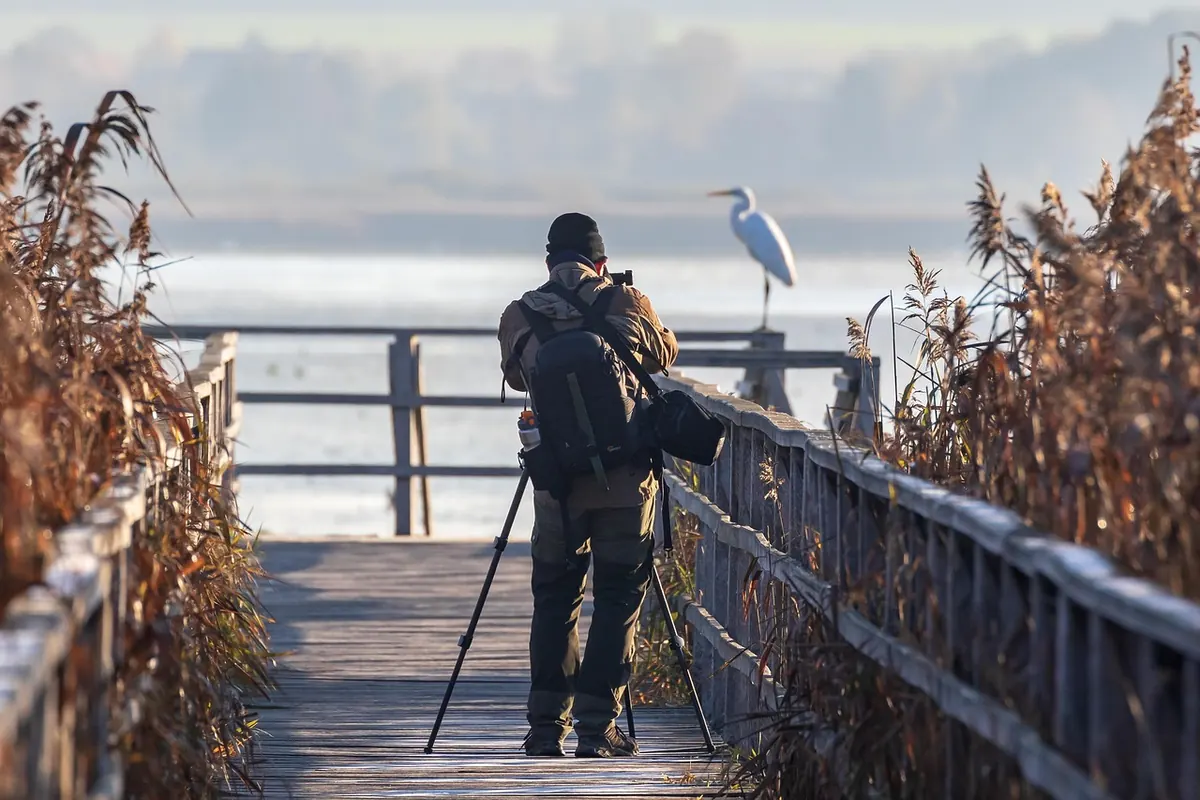
- Harnser — a heron, usually one standing motionless in a dyke.
- Loke — a narrow lane or alley. Common in Norwich street names.
- Mardle — a chat, or to chat. "Have a bit of a mardle" is an invitation, not a chore.
- Squit — nonsense, or a small, insignificant person. Tone decides which.
- Chunter — to grumble quietly while getting on with something else.
- Frit — frightened.
- Ollust — always.
- Duzzy — a term of mild contempt for someone a bit slow on the uptake, usually said with affection.
- Thurble — to poke about at something, or to work at a task without much urgency.
Sayings that do the work of a whole sentence
Some phrases are used so often they function as punctuation. You will hear them in shops, on farms, and at the end of phone calls.
- "Do yew keep a troshin'." A warm goodbye, roughly "keep going, keep at it". The troshin' is threshing, the old harvest work.
- "How do?" Hello. Not a question about your wellbeing, and not usually answered at length.
- "Hold yew hard." Wait a moment. Said with patience or with warning, depending on the eyebrows.
- "Now then." A greeting, not a complaint. Roughly "hello, what's this then".
- "Thass a rum 'un." That's a strange one. Useful for weather, people and council decisions.
- "Ent it." Isn't it. An agreement tagged onto the end of a sentence rather than a real question.
- "Fare yew well." Goodbye, and a slightly gentler one than the troshin' version.
- "He'll do till the boat comes in." Said of something adequate but not good — a genuine Norfolk line, and a reminder that the county has always measured time by the tide.
"Do yew keep a troshin'." — the standard sign-off of a Norfolk conversation, whether you have been talking for two minutes or two hours.
The grammar hiding underneath
Vocabulary is the easy part. The rhythm is where Norfolk really lives, and a few habits explain most of what sounds unfamiliar.
That for it
Where standard English says "it's raining", Norfolk says "thass rainin'". Where standard English says "it's a long way", you get "that's a long way". The pronoun shifts; the meaning doesn't.
Do for emphasis
"He do talk" is not a mistake. That do is doing deliberate work — it marks a habit, something that happens again and again. "They do say" is how rumours travel, and "she do mardle" is not a compliment about her silence.
Vowels pushed backwards
Long o sounds slide towards oo. Home becomes hum, stone becomes stun, road becomes rud, alone becomes alun. It is the fastest way to hear the accent and the hardest thing to fake.
While meaning until
"Wait while I've finished" does not mean wait during my finishing. It means wait until I have finished. The same swap shows up in "I'll be there while four o'clock" — which is a promise about a time, not a duration.
Words for land and water
Norfolk's landscape has its own vocabulary, and much of it has crossed into standard English without anyone noticing.
- Broad — one of the shallow lakes of the Broads, all of them dug by medieval peat cutters and then flooded.
- Dyke — a drainage channel. The county is stitched together with them.
- Staithe — a landing place on a river. You will see the word on signposts at Neatishead, Horning and beyond.
- Pightle — a small enclosed field or paddock, usually beside a house.
- Drove — a road for moving livestock, and the herd itself.
- Wherry — a sailing barge, once the county's fleet of lorries.
Learn a handful of these and you can read a Norfolk map like a local. It is also worth knowing that Norwich is "Norridge" to most people who live there, and Great Yarmouth is usually just Yarmouth.
How to try it without getting it wrong
- Don't perform it. Dialect is a register, not a costume. One word dropped naturally beats a whole sentence delivered in a fake accent.
- Start with the greetings. "How do?" and "Now then" are safe almost anywhere, and they open doors.
- Listen for the rhythm. Norfolk speech is flat and unhurried, with stress landing in different places from standard English. Copying the tune matters more than copying the vowels.
- Respect the difference. Suffolk, just over the Waveney, has its own words and its own accent. Treating the two as one thing is a reliable way to annoy both.
- Ask, don't assume. "What do you call that round here?" is a perfectly good question, and usually gets a better answer than any book.
Where you'll still hear it
Rather than dying out, the dialect has moved. It turns up on Norfolk Day in July, in the songs of the county's folk clubs, in the letters pages of the local papers, and in the chat of any boatyard or livestock market on a Saturday morning. It also arrives by text message, which is a stranger thing than it sounds — "do yew keep a troshin'" reads surprisingly well on a phone screen.
What has gone is the thick, uninterrupted version an eighty-year-old farmer in 1950 might have spoken with another farmer. What remains is a set of words and turns of phrase threaded through ordinary English, available to anyone who wants them. That is how dialects usually end: not with a bang, but a slow leak into the standard.
So the next time someone in a Norfolk pub tells you the weather is looking a bit rum and asks whether you have had a mardle about the dodman, you will know exactly what is on offer — a conversation, a laugh, and a county's worth of history compressed into two sentences.
Photo: DGlodowska / Pixabay