Titchwell Marsh is one of the best places in Norfolk to learn birdwatching because it does most of the work for you. The reserve packs reedbed, fresh lagoon, saltmarsh, dunes and beach into a walk of less than a mile. Birds are often close. Hides give you somewhere to sit, shelter and study. You do not need to know the difference between a dunlin and a curlew before you arrive. You need binoculars, a rough idea of the tide and a willingness to stand still for ten minutes.
Why Titchwell works for beginners
The reserve is compact and the main path is flat and well signposted. You can walk from the visitor centre to the beach in half an hour, or spend three hours doing it properly. There are benches, accessible hides and plenty of people who will happily point out a marsh harrier if you look lost. The visitor centre is the place to check the latest sightings board, ask what has been seen that morning, and pick up a map. Because the habitats change so quickly, a quiet spell on the lagoon can be followed by a busy half-hour on the beach. That variety keeps a first visit interesting even when the birds are not cooperating.
Time your visit around the tide
Tide is the single most useful thing to check before you go. On the north Norfolk coast, the sea can move a long way. At low tide, waders spread across the mudflats and you may struggle to see them without a telescope. As the tide rises, birds are pushed closer to the shore, the lagoons and their roosting spots. The two hours before high tide and the hour after are often the best window. Check a tide table for the north Norfolk coast, using Thornham or Hunstanton as the usual reference points. Tide times shift daily and heights vary with spring and neap cycles. A big spring tide can cover the beach and fill the saltmarsh creeks; a neap tide may barely move the birds at all.
Safety first: never walk out onto the mudflats. The incoming tide can cut you off, and the creeks are deeper than they look. Stay on the beach, the boardwalk and the marked paths.
Best time of day
Early morning is usually best. Birds feed, the light is soft, and fewer people are on the path. In winter, mid-afternoon can be good as birds return to roost. In summer, avoid the middle of a hot day; early or late is more comfortable and more productive.
What each season brings
Winter is the classic wildfowl season. Look for Brent geese, wigeon, teal, pintail and shelduck on the lagoons, with pink-footed geese sometimes moving overhead. Spring brings avocets back to the reserve, bearded tits pinging in the reedbeds, and the chance of a booming bittern. Summer is about breeding birds: avocets with chicks, terns fishing, marsh harriers quartering the reeds. Autumn is migration time, when wader numbers build and almost anything can turn up. The reserve is worth visiting all year, but the experience changes completely from month to month.
The hides and the route
From the visitor centre, a level path leads through a small wooded area to Fen Hide. This is a quiet, sheltered spot, good for a first look at the reedbed and a place to get your binoculars set up without an audience.
Island Hide sits close to the fresh marsh. It is excellent for close views of avocets, ducks and gulls, especially when the water level is high. The windows open, but keep movement slow and quiet.
Parrinder Hide is further along and larger, with wide views over the fresh and brackish marsh. This is often the best hide for scanning waders, wildfowl and birds of prey. If you only have time for one hide, make it this one.
Beyond Parrinder, the path becomes a boardwalk over the saltmarsh and leads to the beach. The beach is where the reserve opens out. Look for sanderling running along the tideline, ringed plover, oystercatcher, turnstone and bar-tailed godwit. On a rising tide, birds are pushed towards you. On a falling tide, they spread out. A telescope helps here, but binoculars will still show you plenty if you pick a comfortable spot and wait.
Common waders and wildfowl to know
Start with size, bill shape, leg colour and behaviour. That is enough to identify most of what you will see at Titchwell.
Waders
- Oystercatcher: black and white, long orange bill, loud piping call. Hard to mistake.
- Avocet: black and white, elegant, with a thin upturned bill. A Titchwell speciality in warmer months.
- Lapwing: greenish back, wispy crest, broad rounded wings. Often in flocks over the marsh.
- Redshank: medium-sized, long red legs, noisy and nervous. Usually the first wader to call alarm.
- Dunlin: small, with a slightly downcurved black bill. Often in tight flocks, feeding in shallow water.
- Sanderling: pale and small, running along the tideline like a wind-up toy. No hind toe, if you get a close look.
- Ringed plover: small, orange legs, black breast band and a smart black-and-white face pattern.
- Curlew: large, with a long downcurved bill and a haunting call. Often on the saltmarsh or beach.
- Black-tailed godwit: long straight bill, orange-brown in summer, with a bold black tail band in flight.
- Turnstone: short bill, orange legs, mottled plumage. Feeds by flipping stones and seaweed on the beach.
Wildfowl
- Shelduck: large, white body, dark green head, red bill. Common on the lagoons.
- Teal: tiny duck, fast and twisting in flight. Look for the green wing patch.
- Wigeon: chestnut head, cream forehead, whistling call. Often grazes on the marsh.
- Shoveler: unmistakable huge spoon-shaped bill. Swims with its head low, filtering water.
- Pintail: slim and elegant, with a pointed tail. Usually seen on the larger lagoons.
- Brent goose: small, dark goose with a black neck and a white flank patch. A winter visitor to the saltmarsh.
Mallard, greylag goose, Canada goose, mute swan and little egret are also common. Do not worry about identifying everything. Learning five species well is better than half-seeing twenty.
Gear that actually helps
- Binoculars with 8x42 or 10x42 magnification. Avoid tiny compacts; they are hard to use in low light.
- A telescope if you already own one. It is useful on the beach, but not essential for a first visit.
- A waterproof jacket and trousers. Coastal weather changes quickly, even on a promising forecast.
- Sturdy boots or wellingtons. The path can be muddy, and the beach is uneven.
- Layers, hat and gloves in winter; sun cream and insect repellent in summer.
- Water, a snack and a flask. The visitor centre may have refreshments, but it is a long walk back from the beach.
- A field guide or a bird identification app on your phone, downloaded for offline use.
- A tide table or a note of high tide times. Do not rely on signal at the beach.
Hide etiquette and fieldcraft
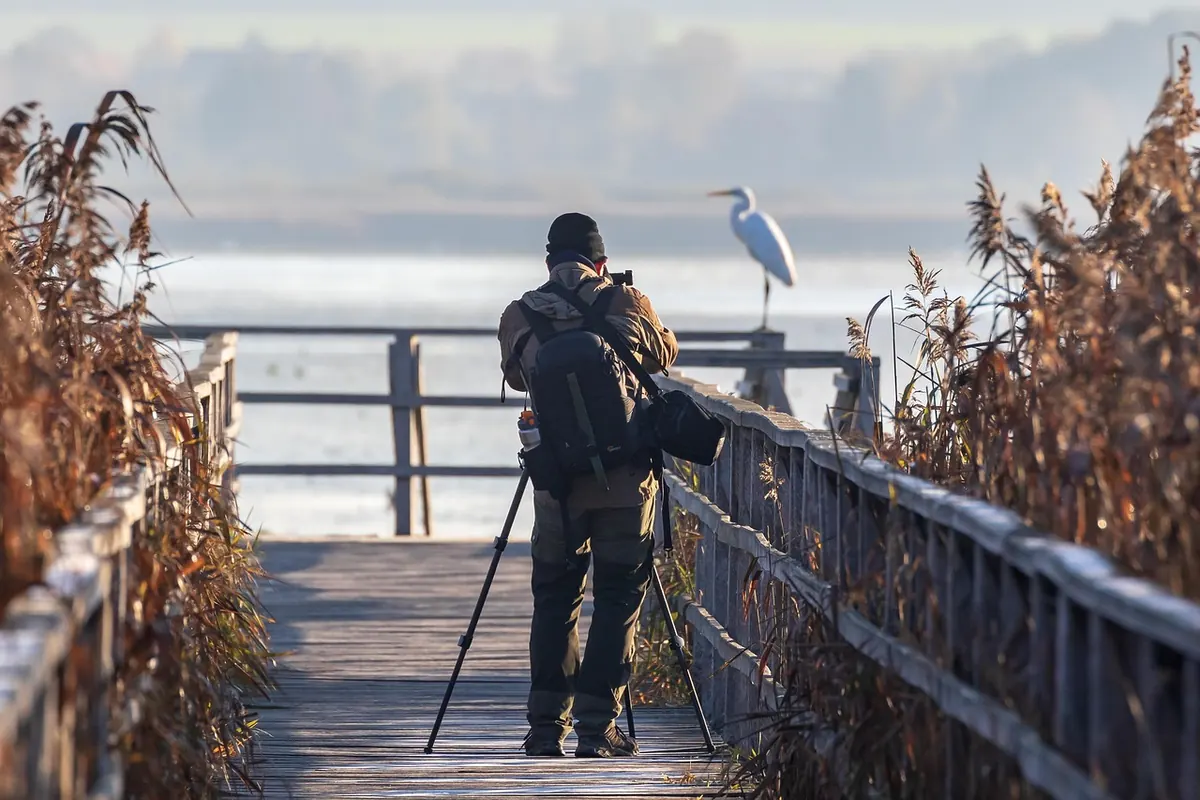
Hides are shared spaces. Open and close doors gently. Speak quietly, or not at all. Do not tap the glass or wave at birds to make them move. If someone is already set up at a window, take another one and give them room. Ask before looking through someone else's telescope; most people will say yes, but it is polite to check. Keep children close and calm. Never feed the birds. Stay on the paths, and check the reserve's dog policy before bringing a dog, as RSPB reserves usually restrict them. Good fieldcraft is simple: move slowly, wear dull colours, keep your silhouette low and let the birds come to you.
A simple plan for your first visit
- Check the tide table the night before and aim to arrive about two hours before high tide.
- Start at the visitor centre, read the sightings board and ask what is showing well.
- Walk to Fen Hide for a gentle warm-up, then continue to Island Hide and Parrinder Hide.
- Spend at least twenty minutes in one hide. Sit still. Let the birds settle around you.
- If the tide is right, walk the boardwalk to the beach and scan the shoreline from a fixed point.
- On the way back, revisit the hides. Light and bird activity often change in an hour.
Take your time and keep your expectations loose. A quiet day at Titchwell still gives you marsh harriers, little egrets, reed buntings and the sound of the wind in the reeds. The birds will do the rest. And if you are unsure what you are looking at, ask. Birdwatchers are usually delighted to help a beginner see something new.
Photo: nidan / Pixabay